Showing posts with label Load. Show all posts

Sunday, 10 July 2016

Tension and Ten-son !!

I was and I am troubling with some of the very easy Definition.(Not jumble in words like tension and ten-son !!)When it is the time of Description I Can manage but when it's question to be particular to words I am so confused, I think at my age it's happened with all. so I share here some of the definitions.


  • Quantity: How much there is or how many there are of something that you can 
  • Elongation: An addition to the length of something.
  • Deformation: Alternation in the shape or dimensions of an object as a result of the application stress to it.

  • Stress: Force that produces strain on a physical body.
  • Strain: Deformation of a physical body under the action of applied forces.
  • Shrinkage: Process, or result of becoming less or smaller
  • Creep: A slow longitudinal movement or deformation 
  • Inelastic: Not able to adjust readily to different conditions.
  • Tension: A stress that produces an elongation of an Elastic physic body.
  • Shear:The Influence that Produces a change in a Physical Quantity.
  • Force: The influence that produce a change in a physical quantity


  • Creep in concrete: progressive increase in the inelastic deformation of concrete under sustained stress component.
  • Shrinkage in concrete: Contraction of concrete on drying.
  • Creep co-officiant: The ratio of the total creep strain to elastic strain in concrete.
  • Cracking load: The load on the structural elements corresponding to the first visible crack.

Wednesday, 15 June 2016

Foundation in Engineering


       Another dangerous word for us is a foundation.Without this, any of the situation may not happen,whether we are thinking of the study we need some strong basic that is known as a foundation of our career.In the makeup of life or make of structure, we require the foundation.A good enough foundation is the necessity to a Good structure. So the first question arises what is foundation?What is the use of it? The requirement for the Good foundations are what?

The foundations of buildings bear on and transmit loads to the ground.The foundation is that part of walls, piers, and columns in direct contact with and transmits loads to the ground.The principal foundation type is the strip, pad, raft, and pile foundations as illustrated.

strap foundation is a continues strip of concrete under walls, a pad an isolated base under piers  and columns, a raft a continuous base under the whole building, and a pile concrete column or pillar cast in or driven into the ground to support a concrete base or ground beam.

The ground is the general term for the earth's surface,which varies in composition within the two main groups, rocks, and soils.Rocks include the hard, rigid ,rocks and soils

Requirements for good foundation:

A foundation to serve its purpose needs to satisfy the following criteria.
  1. The foundations should sustain the dead and imposed loads and transmit these to the sub-soil in such a way that pressure on it will not cause settlement which would impair the stability of the building or adjoining structures.
  2. The base of the foundation should be rigid so that differential settlements are minimized, especially for the case when superimposed loads are not evenly distributed.
  3. Foundations should be taken sufficiently deep to guard the building against damage or distress caused by swelling-shrinkage of the sub-soil.
  4. Foundations should be so located that its performance may not be affected due to any unexpected future influence.
Types of foundation:

There are two types of foundation
1> shallow foundation
2>  deep foundation

We will see more details about the foundation in next post.keep reading.

Saturday, 4 June 2016

Load


    From the beginning of engineering we listen to a word 'load'.The importance of the load and more than that type of load.so here I try to elaborate the word load and it's typed.

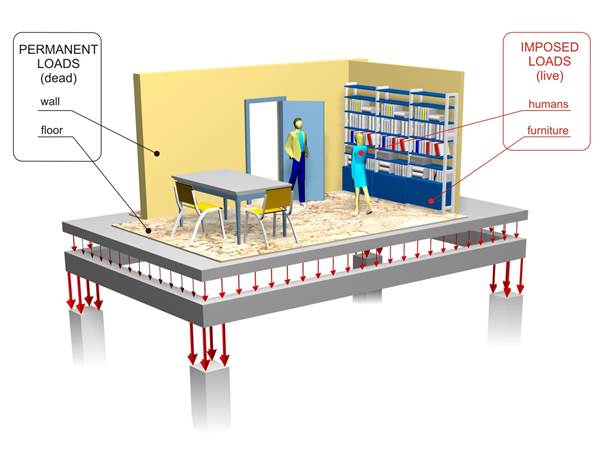
A heavy or bulky thing that is being carried or is about to be carried is known as a load.In another word A, weight or source of pressure borne by someone or something is a load.The below Picture shows what load is.


 Structural members must be designed to support specific loads. Loads are those forces for which a structure should be proportioned. Loads that act on the structure can be divided into three categories.
  1. Dead loads
  2. Live loads
  3. Environmental loads

Dead Loads:
Dead loads are those that are constant in magnitude and fixed in location throughout the lifetime of the structure. It includes the weight of the structure and any permanent material placed on the structure, such as roofing, tiles, walls etc. They can be determined with a high degree of accuracy from the dimensions of the elements and the unit weight of the material.


Live loads:
Live loads are those that may vary in magnitude and may also change in location. Live loads consist chiefly occupancy loads in buildings and traffic loads in bridges. Live loads at any given time are uncertain, both in magnitude and distribution.


Environmental loads:
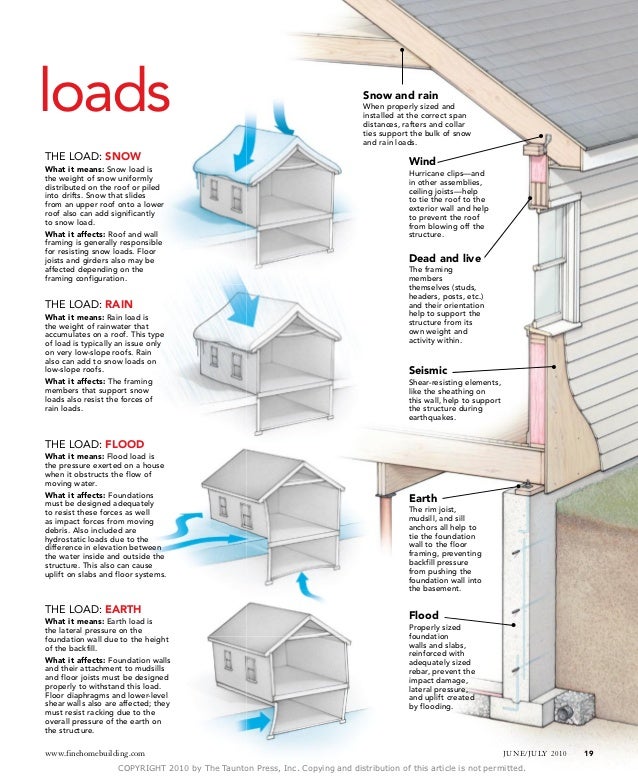
Consists mainly of snow loads, wind pressure and suction, earthquake loads (i.e inertial forces) caused by earthquake motions. Soil pressure on a subsurface portion of structures loads from possible ponding of rainwater on flat surfaces and forces caused by temperature differences. Like live loads, environmental loads at any given time are uncertain both in magnitude and distribution.